Ripening-Driven Anthocyanin and Vitamin C Accumulation in Flacourtia inermis: Evidence from an Underutilized Tropical Fruit in Lombok, Indonesia
DOI:
https://doi.org/10.33096/jffi.v13i1.9pd0nf46Keywords:
Flacourtia inermis, anthocyanin, vitamin C, ripening stage, fuctional foodAbstract
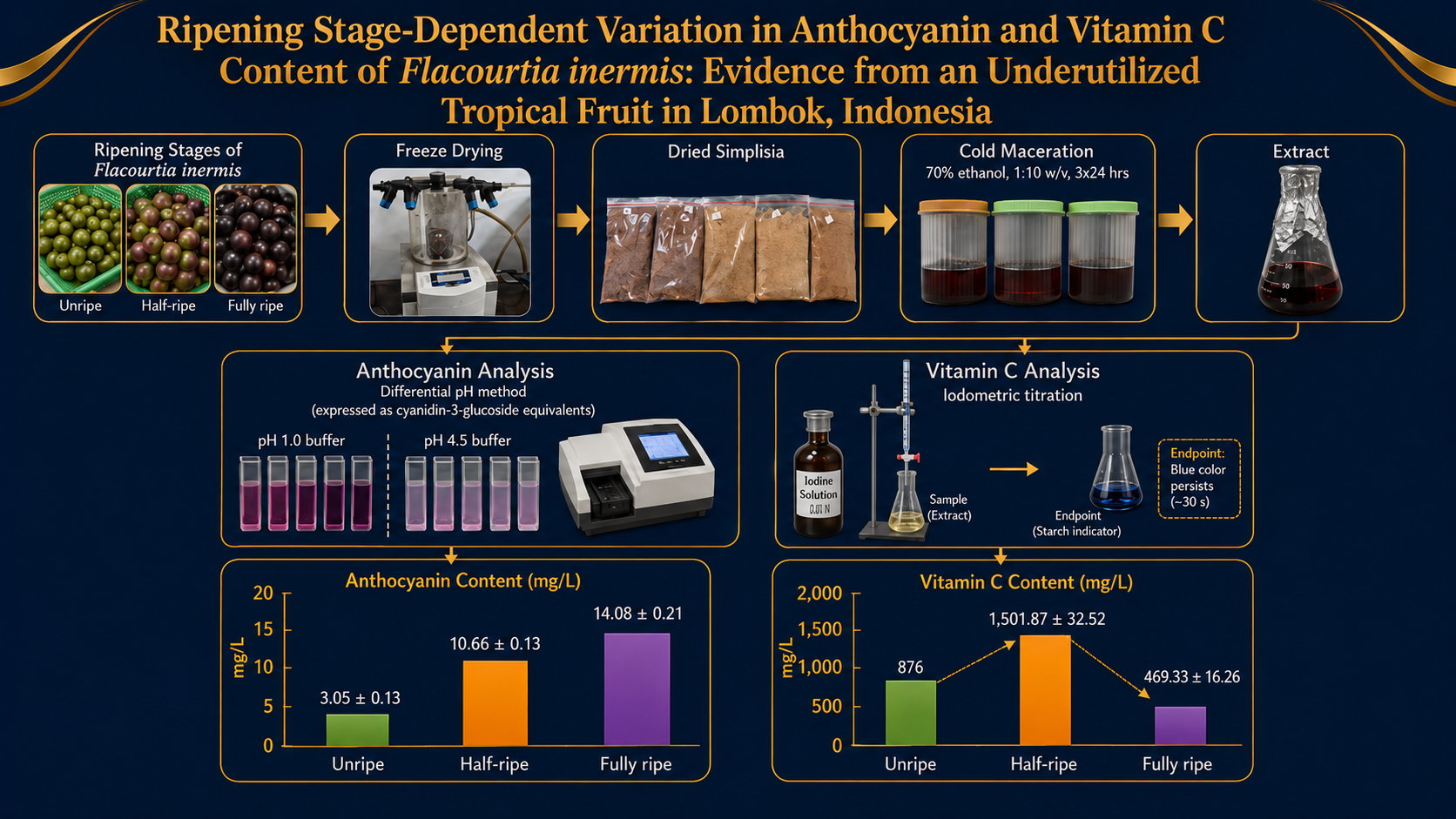
Oxidative stress is associated with the progression of chronic diseases, increasing scientific interest in fruit-derived phytochemicals as sources of bioactive compounds. Lobi-lobi (Flacourtia inermis), a tropical fruit native to Indonesia, contains anthocyanins and vitamin C; however, quantitative evidence on how ripening affects these compounds remains limited. This study aimed to evaluate changes in anthocyanin and vitamin C content across ripening stages of F. inermis to identify the maturity stage with the highest bioactive compound levels.
An experimental laboratory study with a post-test-only design was conducted using freeze-dried fruits categorized as unripe, half-ripe, and fully ripe. Anthocyanin content was measured using the differential pH method, while vitamin C levels were determined through iodometric titration. Data were expressed as mean ± standard deviation and analyzed using ANOVA or Kruskal-Wallis tests with a significance level of p < 0.05.
Anthocyanin content increased with fruit maturation, from 3.05 ± 0.13 mg/L in unripe fruits to 10.62 ± 0.09 mg/L in half-ripe fruits and 14.16 ± 0.11 mg/L in fully ripe fruits. In contrast, vitamin C levels were highest in half-ripe fruits (1495.61 ± 28.68 mg/L) and decreased in fully ripe fruits (456.81 ± 10.84 mg/L).
These findings indicate that ripening stage influences anthocyanin and vitamin C accumulation in Flacourtia inermis. Half-ripe fruits may represent an optimal harvest stage for maximizing the combined presence of these bioactive compounds and support the potential use of lobi-lobi as a functional tropical fruit.
Downloads
References
Adriani, R.B. et al. (2023) “The Effect of Blueberry Consumption on Non-communicable Diseases.”
Astari, P., Yulianti, E. and Ferdinal, F. (2024) “Phytochemical Test, Total Antioxidant Capacity and Toxicity of Lobi-Lobi Fruit Extract: (Flacourtia Inermis),” International Journal of Social Health, 3(7), pp. 404–411. Available at: https://doi.org/10.58860/ijsh.v3i7.212.
Fenech, M. et al. (2019) “Vitamin C Content in Fruits: Biosynthesis and Regulation,” Frontiers in Plant Science, 9, p. 2006. Available at: https://doi.org/10.3389/fpls.2018.02006.
Kumoro, A.C., Alhanif, M. and Wardhani, D.H. (2020) “A Critical Review on Tropical Fruits Seeds as Prospective Sources of Nutritional and Bioactive Compounds for Functional Foods Development: A Case of Indonesian Exotic Fruits,” International Journal of Food Science, 2020, pp. 1–15. Available at: https://doi.org/10.1155/2020/4051475.
Liu, Q. et al. (2026) “Decoding polyphenol–protein interactions with deep learning: From molecular mechanisms to food applications,” Biotechnology Advances, 87, p. 108803. Available at: https://doi.org/10.1016/j.biotechadv.2026.108803.
Mattioli, R. et al. (2020) “Anthocyanins: A Comprehensive Review of Their Chemical Properties and Health Effects on Cardiovascular and Neurodegenerative Diseases,” Molecules, 25(17), p. 3809. Available at: https://doi.org/10.3390/molecules25173809.
Mustaqim, W.A. and Raihandhany, R. (2020) “Flacourtia inermis Roxb. Salicaceae,” in F.M. Franco (ed.) Ethnobotany of the Mountain Regions of Southeast Asia. Cham: Springer International Publishing (Ethnobotany of Mountain Regions), pp. 1–6. Available at: https://doi.org/10.1007/978-3-030-14116-5_158-1.
Parijadi, A.A.R. et al. (2018) “Metabolic profiling of Garcinia mangostana (mangosteen) based on ripening stages,” Journal of Bioscience and Bioengineering, 125(2), pp. 238–244. Available at: https://doi.org/10.1016/j.jbiosc.2017.08.013.
Sapian, S. et al. (2022) “The Role of Anthocyanin in Modulating Diabetic Cardiovascular Disease and Its Potential to Be Developed as a Nutraceutical,” Pharmaceuticals, 15(11), p. 1344. Available at: https://doi.org/10.3390/ph15111344.
Sarkar, T. et al. (2023) “Minor tropical fruits as a potential source of bioactive and functional foods,” Critical Reviews in Food Science and Nutrition, 63(23), pp. 6491–6535. Available at: https://doi.org/10.1080/10408398.2022.2033953.
Shen, J., Wan, S. and Tan, H. (2024) “Postharvest litchi (Litchi chinensis Sonn.) quality preservation by alginate oligosaccharides.” arXiv. Available at: https://doi.org/10.48550/arXiv.2403.01383.
Syafitri, N. et al. (2023) “DETERMINATION OF ASCORBIC ACID CONCENTRATION IN MYRTACEAE USING THE IODOMETRIC TITRATION METHOD,” Jurnal Pena Sains, 10(1), pp. 28–33. Available at: https://doi.org/10.21107/jps.v10i1.19161.
Umam, M.N., Poerwanto, R. and Matra, D.D. (2023) “Morphological and phytochemical characterization of Lobi-lobi fruit (Flacourtia inermis) at each maturity stage,” AIP Conference Proceedings, 2616(1), p. 050007. Available at: https://doi.org/10.1063/5.0135756.
Yasin, F.M., Zam, Z.Z. and Rakhman, K.A. (2022) “Analysis Of Antioxidant Content Of Anthocyanin In The Lobi-Lobi Fruit (Flacourtian Inermis) And Jamblang Fruit (Syzygium Cumini L Skeel) Using The Dpph Method With Spectrophotometry,” Jurnal Biosains Pascasarjana, 24(1), pp. 8–14. Available at: https://doi.org/10.20473/jbp.v24i1.2022.8-14.
Zheng, X. et al. (2022) “Metabolism and Regulation of Ascorbic Acid in Fruits,” Plants, 11(12), p. 1602. Available at: https://doi.org/10.3390/plants11121602.
Downloads
Published
Issue
Section
License
Copyright (c) 2026 Muhammad Yogi Awaluddin Alrizki, Musyarrafah Musyarrafah, Suci Nirmala, Abdillah Adipatria Budi Azhar (Author)

This work is licensed under a Creative Commons Attribution-ShareAlike 4.0 International License.
How to Cite