Wound Healing Potential of Artocarpus lanceifolius Roxb. Methanolic Extracts in Hyperglycemic Wounds
DOI:
https://doi.org/10.33096/jffi.v13i1.natkgp66Keywords:
Artocarpus lanceifolius, methanol extracts, hyperglycemic wound, wound healing, in vivoAbstract
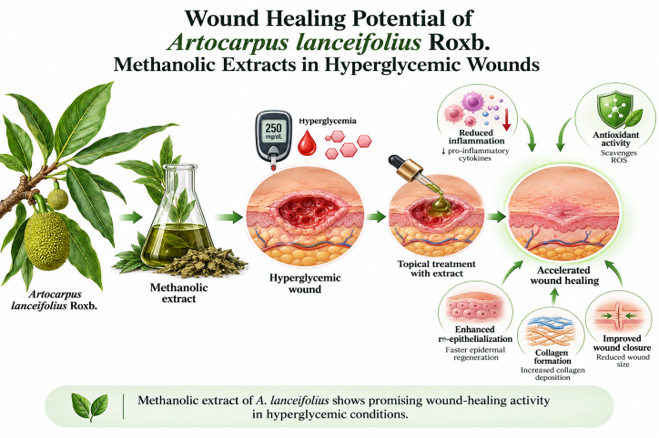
The bark of Artocarpus lanceifolius Roxb. has potential as a natural wound-healing agent because it contains secondary metabolites with various biological activities. This study aimed to evaluate the wound-healing activity of a methanol extract of A. lanceifolius bark in a hyperglycemic animal model. An in vivo study was conducted using hyperglycemic experimental animals that were subsequently induced with wounds. The animals were divided into a negative control group (Na-CMC), a positive control group (povidone-iodine), and treatment groups that received methanol extract of A. lanceifolius bark at concentrations of 10%, 20%, and 30%. Observations were made on days 0, 3, 7, 11, 12, and 14. The primary parameters evaluated were changes in wound length and the percentage of wound healing. All treatment groups showed a progressive decrease in wound length throughout the observation period. The negative control group exhibited the slowest healing response, with wound length decreasing from 1 cm on day 0 to 0.36 cm on day 14. Treatment with the methanol extract resulted in a progressive increase in the percentage of wound healing over time. On day 14, the wound healing percentage reached 77% at a 10% methanol extract concentration, 89% at 20%, and 100% at 30%. The 30% methanol extract demonstrated the highest healing response, reaching complete wound closure on day 12. The wound-healing activity of the methanol extract may be associated with its secondary metabolites, particularly flavonoids, phenolic compounds, and tannins, which may contribute through antioxidant and anti-inflammatory activities that support tissue repair under hyperglycemic conditions. The methanol extract of A. lanceifolius Roxb. bark demonstrated potential wound-healing activity in a hyperglycemic animal model, with the 30% concentration exhibiting the most optimal activity compared with the 10% and 20% concentrations.
Downloads
References
Amparo, T.R. et al. (2020) ‘Herbal Medicines to The Treatment of Skin and Soft Tissue Infections: Advantages of The Multi‐Targets Action’, Phytotherapy Research, 34(1), pp. 94–103. Available at: https://doi.org/10.1002/ptr.6519.
Burgess, J.L. et al. (2021) ‘Diabetic Wound-Healing Science’, Medicina, 57(10), p. 1072. Available at: https://doi.org/10.3390/medicina57101072.
Chen, L. et al. (2025) ‘Global Landscape and Translational Trajectories of Flavonoid-Based Wound-Healing Research’, Drug Discovery Today, 30(10), p. 104461. Available at: https://doi.org/10.1016/j.drudis.2025.104461.
Chen, L.-Y. et al. (2020) ‘Effects of Rutin on Wound Healing in Hyperglycemic Rats’, Antioxidants, 9(11), p. 1122. Available at: https://doi.org/10.3390/antiox9111122.
Chen, Y. et al. (2021) ‘Glucose-Triggered in Situ Forming Keratin Hydrogel for The Treatment of Diabetic Wounds’, Acta Biomaterialia, 125, pp. 208–218. Available at: https://doi.org/10.1016/j.actbio.2021.02.035.
Cushnie, T.P.T., Cushnie, B. and Lamb, A.J. (2014) ‘Alkaloids: An Overview of Their Antibacterial, Antibiotic-Enhancing and Antivirulence Activities’, International Journal of Antimicrobial Agents, 44(5), pp. 377–386. Available at: https://doi.org/10.1016/j.ijantimicag.2014.06.001.
Deng, L. et al. (2021) ‘The Role of Oxidative Stress and Antioxidants in Diabetic Wound Healing’, Oxidative Medicine and Cellular Longevity [Preprint]. Available at: https://doi.org/10.1155/2021/8852759.
Esad, M. et al. (2025) ‘Molecular Mechanisms of Wound Healing: The Role of Medicinal Plants’, Life, 15(11), p. 1748. Available at: https://doi.org/10.3390/life15111748.
Godlewska, K. et al. (2022) ‘Methods for Rapid Screening of Biologically Active Compounds Present in Plant-Based Extracts’, Molecules, 27(20), p. 7094. Available at: https://doi.org/10.3390/molecules27207094.
Hasan, H. et al. (2019) ‘Determination of Secondary Metabolites, Toxicity and Antioxidant Activities of Bark Extracts of Artocarpus Lanceifolius Roxb’, International Research Journal Of Pharmacy, 10(2), pp. 61–64. Available at: https://doi.org/10.7897/2230-8407.100243.
Hasan, H. et al. (2023) ‘Chemical Components of Artocarpus lanceifolius Roxb and Antioxidant Activity’, AIP Conference Proceedings, 2588(1). Available at: https://doi.org/10.1063/5.0112313.
Hossain, M.A. et al. (2013) ‘Study of Total Phenol, Flavonoids Contents and Phytochemical Screening of Various Leaves Crude Extracts of Locally Grown Thymus Vulgaris’, Asian Pacific Journal of Tropical Biomedicine, 3(9), pp. 705–710. Available at: https://doi.org/10.1016/S2221-1691(13)60142-2.
Isa, M.A.A. et al. (2025) ‘Potensi Fraksi Kulit Batang Kaledang (Artocarpus lanceifolius Roxb.) Sebagai Tabir Surya Secara In Vitro’, Jurnal Fitofarmaka Indonesia, 12(2), pp. 61–66. Available at: https://doi.org/10.33096/jffi.v12i2.1400.
Reiza, I.A., Rijai, L. and Mahmudah, F. (2019) ‘Skrining Fitokimia Ekstrak Etanol Kulit Nanas (Ananas comosus (L.) Merr)’, Proceeding of Mulawarman Pharmaceuticals Conferences, 10, pp. 104–108. Available at: https://doi.org/10.25026/mpc.v10i1.371.
Samavati, S.S. et al. (2025) ‘Accelerated Wound Healing Through Tannin-Rich Jaft Extract, Concentration-Dependent Efficacy and Mechanistic Insights from Quercus brantii Ointment Formulations’, Scientific Reports, 15(1), p. 29004. Available at: https://doi.org/10.1038/s41598-025-13832-4.
Sanchez, M.C. et al. (2018) ‘Targeting Oxidative Stress and Mitochondrial Dysfunction in the Treatment of Impaired Wound Healing: A Systematic Review’, Antioxidants, 7(8), p. 98. Available at: https://doi.org/10.3390/antiox7080098.
Shaikh, S.S. (2026) ‘Saponins and Skin Regeneration – A Natural Path to Healing: Harnessing Plant-Based Bioactives for Enhanced Skin Healing and Renewal’, African Journal of Medicine and Pharma Research, 3(2), pp. 73–82. Available at: https://doi.org/10.18231/j.ajmpr.35030.1767590642.
Sutoyo, S. et al. (2021) ‘Phytochemical Screening, Total Flavonoid Content, and Total Phenolic Content of Ethanol Extract of the Indonesian Fern Selaginella Plana’, International Joint Conference on Science and Engineering 2021 (IJCSE 2021). Atlas Press, pp. 357–362.
Sychrová, A. et al. (2022) ‘Prenylated Flavonoids in Topical Infections and Wound Healing’, Molecules, 27(14), p. 4491. Available at: https://doi.org/10.3390/molecules27144491.
Valentino, C. et al. (2023) ‘Characterization and Molecular Modelling of Non-Antibiotic Nanohybrids for Wound Healing Purposes’, Pharmaceutics, 15(4), p. 1140. Available at: https://doi.org/10.3390/pharmaceutics15041140.
Yadav, P.S. et al. (2025) ‘Therapies and Delivery Systems for Diabetic Wound Care: Current Insights and Future Directions’, Frontiers Pharmacology, 16. Available at: https://doi.org/10.3389/fphar.2025.1628252.
Yan, Y. et al. (2021) ‘Research Progress on Antibacterial Activities and Mechanisms of Natural Alkaloids: A Review’, Antibiotics, 10(3), p. 318. Available at: https://doi.org/10.3390/antibiotics10030318.
Yazarlu, O. et al. (2021) ‘Perspective on The Application of Medicinal Plants and Natural Products in Wound Healing: A Mechanistic Review’, Pharmacological Research, 174, p. 105841. Available at: https://doi.org/10.1016/j.phrs.2021.105841.
Yudaev, P. et al. (2023) ‘Wound Gel with Antimicrobial Effects Based on Polyvinyl Alcohol and Functional Aryloxycyclotriphosphazene’, Polymers, 15(13), p. 2831. Available at: https://doi.org/10.3390/polym15132831.
Zhang, X.-Z. et al. (2026) ‘Natural Alkaloids as Antimicrobial Agents: Mechanisms, Potentials and Challenges’, Molecules, 31(7), p. 1204. Available at: https://doi.org/10.3390/molecules31071204.
Zhang, Y. et al. (2023) ‘PLGA@IL-8 nanoparticles-loaded acellular dermal matrix as a delivery system for exogenous MSCs in diabetic wound healing’, International Journal of Biological Macromolecules, 224, pp. 688–698. Available at: https://doi.org/10.1016/j.ijbiomac.2022.10.157.
Zulkefli, N. et al. (2023) ‘Flavonoids as Potential Wound-Healing Molecules: Emphasis on Pathways Perspective’, International Journal of Molecular Sciences, 24(5), p. 4607. Available at: https://doi.org/10.3390/ijms24054607.
Downloads
Published
Issue
Section
License
Copyright (c) 2026 Hamsidar Hasan (Author); Widysusanti Abdulkadir (Translator); Endah Djuwarno, Mahdalena Sy Pakaya (Author); Nazwa Zaharani Yusuf (Translator)

This work is licensed under a Creative Commons Attribution-ShareAlike 4.0 International License.
How to Cite